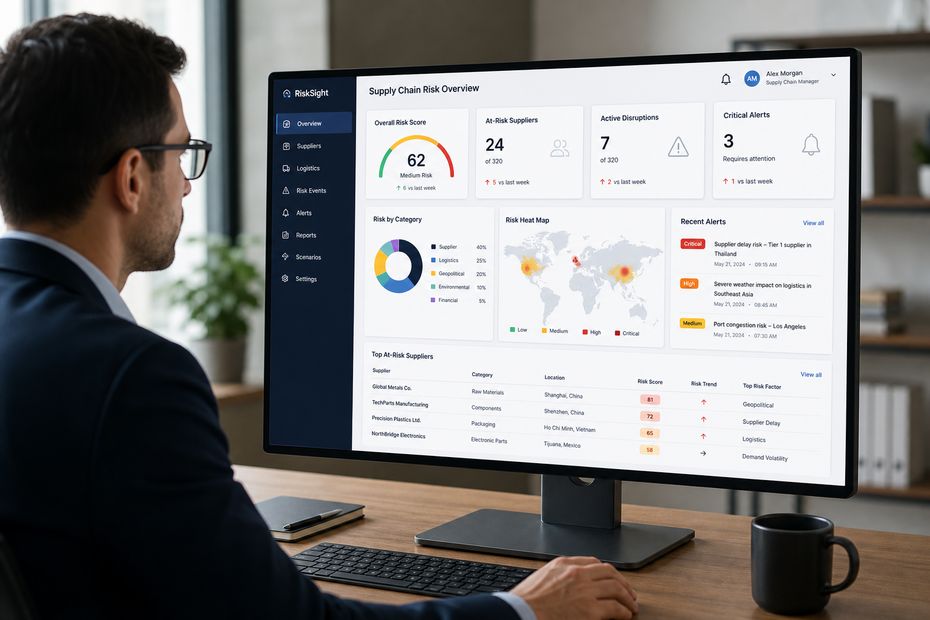
Supply chain risk platforms monitor supplier, logistics, weather, geopolitical, cyber, and operational signals, then connect alerts to the suppliers, sites, parts, or shipments that could affect your business. The right platform matches your main exposure, maps dependencies beyond tier 1, and sends actionable alerts into the systems your teams already use.
Choosing a platform requires more than comparing feature lists. You need to understand what the software monitors, how it verifies events, whether it can identify hidden supplier relationships, and how alerts lead to action. These decision criteria help you separate useful risk intelligence from another dashboard your team has to maintain.
Why Has Supply Chain Risk Monitoring Moved Beyond Tier 1?
Your direct suppliers represent only the visible edge of your supplier network. A tier 1 supplier may depend on a single sub-tier manufacturer, processing site, raw material source, or transport hub that never appears in your enterprise resource planning (ERP) system. If that hidden dependency fails, several direct suppliers can be affected at once.
Multi-tier mapping links suppliers to their sites, products, materials, and upstream relationships. It can expose geographic concentration, shared sub-tier suppliers, and single-source dependencies that traditional supplier lists miss. Gartner identifies multitier supplier visibility as a requirement for proactive supply chain and risk management.
The financial case for earlier detection is substantial. McKinsey & Company estimates that disruptions lasting at least one month occur every 3.7 years on average across industries. Its analysis also estimates that supply chain disruptions can erase about 42% of one year’s earnings before interest, taxes, depreciation, and amortization over a decade.
What Do Supply Chain Risk Platforms Actually Monitor?
Supply chain risk platforms collect external events and internal business data, then determine where those signals intersect with your operations. Common event categories include facility fires, extreme weather, port closures, labor disputes, supplier financial problems, cyber incidents, infrastructure failures, transport delays, and geopolitical developments. The platform’s value depends on whether it can connect an event to a supplier, site, part, purchase order, lane, or shipment.
Supplier risk intelligence platforms focus on companies and business relationships. They monitor supplier health, geographic exposure, operational incidents, risk scores, and upstream dependencies. Logistics visibility software takes a different view, tracking goods in motion and producing estimated times of arrival (ETAs), delay warnings, route information, and shipment exceptions.
A supply chain control tower may combine planning, inventory, orders, transport, and risk data in one operational view. A dedicated risk platform usually provides deeper event monitoring, supplier mapping, or risk scoring. Your organization may need one system, or it may connect a risk intelligence product to a visibility platform and existing control tower.
Which Capabilities Should You Evaluate?
Begin with multi-tier supply chain mapping. Ask how the platform discovers tier 2 and tier 3 relationships, how it validates those links, and whether suppliers must complete questionnaires. Automated discovery can expand coverage faster, but supplier-confirmed data can improve accuracy for sensitive products and manufacturing sites.
Review the alerting process just as carefully. A useful alert identifies the event, affected location, potentially exposed suppliers, related materials or shipments, urgency, and recommended owner. Configurable thresholds, duplicate suppression, materiality scoring, and escalation rules can reduce alert fatigue.
Integration also shapes day-to-day value. Check whether the software connects with your ERP, transportation management system (TMS), procurement suite, supplier management tools, and business communication channels. Application programming interfaces (APIs), data exports, workflow automation, role-based access, and audit records can determine whether risk monitoring becomes part of operations or remains an isolated dashboard.
How Do Platforms Detect Supply Chain Disruptions?
Disruption monitoring tools scan combinations of news reports, local publications, weather feeds, transport data, company information, public records, supplier responses, and customer data. Some products also analyze social media and multilingual regional sources. Wider source coverage can improve detection, yet volume alone doesn’t guarantee useful alerts.
Artificial Intelligence (AI), machine learning, and natural language processing help platforms classify events, extract company and location names, translate reports, identify relationships, and remove duplicate stories. Human analysts may review uncertain or severe events before customers receive an alert. You should ask vendors which stages are automated, which receive analyst review, and how the platform measures relevance.
Predictive risk analytics requires careful evaluation. A platform may forecast weather exposure, estimated arrival delays, lane risk, supplier stress, or the likely operational effect of an identified event. That isn’t the same as predicting every geopolitical event or facility failure before it occurs. Ask vendors to define each prediction, show how it was tested, and explain how far ahead it can support a reliable decision.
Which Supply Chain Risk Platforms Should You Compare?
The products below address different parts of supply chain disruption monitoring. Some center on supplier networks and sub-tier dependencies, and others concentrate on shipments, transport lanes, or facility operations. Your shortlist should reflect the risk decisions your teams need to make.
- Resilinc: Resilinc combines Multi-Tier Mapping, EventWatchAI, supplier assessments, risk scoring, and collaboration workflows. It is designed to connect global disruption events with suppliers, sites, materials, and other exposed points in a customer’s network.
- Everstream Analytics: Everstream Analytics combines event monitoring, weather intelligence, supplier network mapping, lane analysis, and predictive risk analytics. Its logistics capabilities can help teams evaluate planned routes, monitor active shipments, and identify emerging delay causes.
- interos.ai: interos.ai uses automated relationship mapping, continuous monitoring, risk profiles, scores, and alerts across extended supplier networks. It is geared toward organizations that need to discover sub-tier relationships and compare supplier exposure across several risk categories.
- Prewave: Prewave monitors regional, local, and international sources using AI-based multilingual analysis. Its platform focuses on supplier monitoring, event detection, alerts, risk categories, and early warnings drawn from local-language information.
- project44: project44 centers on transportation management, real-time shipment visibility, predictive ETAs, disruption management, and exception routing. It supports multiple transport modes and suits teams that need to understand where goods are, whether they will arrive on time, and which delays need intervention.
- FourKites: FourKites provides real-time supply chain visibility, predictive arrival information, exception management, and yard operations capabilities. It can connect in-transit information with facility activity, helping teams adjust appointments, labor, docks, and yard priorities.
- Sphera Supply Chain Risk Management: Sphera has integrated riskmethods and SupplyShift into its supply chain risk management offering. The platform supports multi-tier mapping, global disruption monitoring, supplier assessments, risk identification, and compliance processes.
Supplier-focused products and logistics visibility platforms shouldn’t be judged by the same scorecard. A procurement team seeking sub-tier supplier discovery has different requirements from a logistics team seeking live container status and predictive ETAs. Larger organizations may connect the two categories so an external event can be traced from an affected supplier to open orders and active shipments.
How Should You Choose a Supply Chain Risk Platform?
Define the decisions the platform must improve before scheduling vendor demonstrations. You may need to identify exposed production sites after an event, monitor supplier financial health, track delayed freight, uncover shared sub-tier dependencies, or prioritize alternative suppliers. Rank those use cases by financial exposure, operational urgency, and frequency.
Use a controlled pilot with real supplier, site, lane, and shipment data. Measure how many relevant events the platform identifies, how quickly it identifies them, how accurately it maps exposure, and how much analyst work is required. Include procurement, logistics, operations, information technology, security, and supplier management teams in the review.
Compare total cost rather than license price alone. Include implementation, integration, supplier onboarding, data cleansing, user training, configuration, support, and ongoing data maintenance. You can estimate return on investment by measuring reduced event assessment time, avoided production losses, fewer expedited shipments, lower manual monitoring effort, and faster recovery decisions.
What Common Problems Should You Address Before Buying?
Alert fatigue can weaken trust faster than limited event coverage. If teams receive hundreds of low-priority notifications, they may overlook the disruption that requires immediate action. Test filtering, severity settings, role-based routing, duplicate removal, and business-impact scoring during the pilot.
Incomplete supplier data can also limit results. Misspelled company names, missing site addresses, duplicate records, outdated ownership data, and suppliers listed only at corporate level make event matching harder. Clean your supplier master data and decide which suppliers, parts, sites, and purchase orders must be mapped first.
Unclear ownership creates another failure point. An alert has little value if nobody knows who validates exposure, contacts suppliers, changes transport plans, approves alternative sourcing, or updates leadership. Build escalation paths, response deadlines, and decision rights before launch, then test them through disruption exercises.
How Can You Improve Results After Implementation?
Treat deployment as an operating change, not a software installation. Review alert quality, response time, supplier coverage, user adoption, unresolved actions, and false positives at regular intervals. Adjust thresholds when teams receive too much noise or miss events that later affect operations.
Expand coverage in stages. Start with suppliers, sites, materials, and lanes tied to revenue, scarce components, long replenishment times, or limited alternatives. Add lower-risk areas after your response process is stable and your teams can handle the alert volume.
Connect monitoring to mitigation plans. Supplier risk scores become more useful when buyers can identify approved alternatives, inventory buffers, substitute materials, recovery contacts, and continuity plans. Shipment alerts become more useful when logistics teams can reroute freight, change modes, revise appointments, or communicate updated delivery expectations.
What Are the Best Platforms to Monitor Supply Chain Disruptions?
- Resilinc
- Everstream Analytics
- interos.ai
- Prewave
- project44
Choose for the Decisions You Need to Make
The strongest supply chain risk platforms connect external events to your actual suppliers, parts, sites, orders, lanes, and shipments. Supplier mapping matters when your exposure sits beyond tier 1, and real-time shipment visibility matters when delays are already moving through the transport network. Evaluate alert relevance, data quality, integration effort, ownership, and response speed before relying on feature counts. A focused pilot will show whether a platform shortens decision time and supports measurable action. Choose the product that helps your teams find exposure, assign responsibility, and reduce disruption impact before the cost spreads through the business.
References
- McKinsey & Company: Risk, Resilience, and Rebalancing in Global Value Chains
- Gartner: Supply Chain Risk Management
- Gartner: Multitier Supplier Visibility
- World Economic Forum: Global Risks Report
- Resilinc
- Everstream Analytics
- interos.ai
- Prewave Monitoring and Alerting
- project44
- FourKites
- Sphera Supply Chain Risk Management.
